
Interest Rates Rise: Sellers Beware!
Why yesterday's home prices might not reflect what today's buyers can afford.
When homeowners decide to sell their property, one of the first questions they ask is, "How much can I sell my home for?"
It's a reasonable question. After all, sellers want to maximize their return, and understanding their home's market value is the first step. But there's one factor many sellers overlook when determining their asking price: interest rates. The impact can be much greater than you might think.
Buyers and Sellers Are Competing, Just Not in the Way You Think
It's easy to imagine buyers and sellers competing during a real estate transaction. The seller wants the highest possible price, while the buyer wants to pay the least. Offers are made, counteroffers are exchanged, and eventually both parties hope to find common ground.
But there's another competition happening that sellers often fail to recognize, and it revolves around the single most important number in most buyers' purchasing decisions. Spoiler alert: It's not the sales price, the location, or even the number of bedrooms. It's the monthly payment.
While sellers are focused on the total sales price, buyers are often focused on something entirely different: their monthly cash flow. Buyers aren't simply asking themselves whether they can afford a $500,000 home; they're asking whether they can afford the monthly payments associated with owning that home. And when interest rates rise, that monthly payment can change dramatically.
Let's Do Some Math
Imagine you're shopping for a $500,000 home with a 3% down payment and a 30-year mortgage.At a 5% interest rate, your monthly principal and interest payment would be approximately $2,604.
Now let's take that exact same house, with the exact same down payment, and change just one thing: the interest rate.
At 7.5%, your monthly payment jumps to approximately $3,392. That's a difference of $788 per month, or nearly $9,500 annually! I don't know about you, but an additional $788 every month is a lot of money to most households. And remember, we haven't even factored in property taxes, insurance, or other ownership expenses. For many buyers, that additional $788 isn't just inconvenient. It could be the difference between qualifying for the home and being priced out of the market altogether.
Here's Where Sellers Should Pay Attention
Let's reverse the equation:
Suppose a buyer was comfortable purchasing a $500,000 home when mortgage rates were 5%. How much could that same buyer afford at 7.5% while maintaining the same monthly payment? The answer is approximately $384,000.
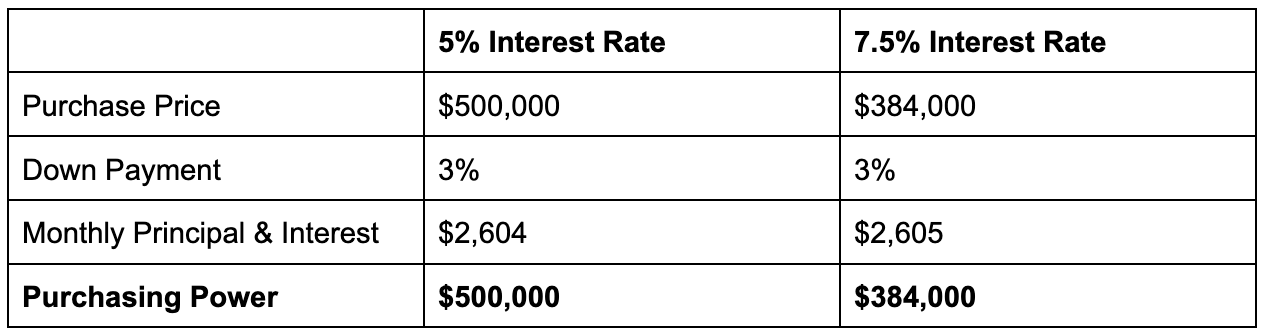
Based on a 30-year fixed-rate mortgage with 3% down. Payments exclude taxes, insurance, and mortgage insurance.
Read that again.
A 2.5-percentage-point increase in mortgage rates just reduced that buyer's purchasing power by more than $116,000, or 23%. The buyer's income hasn't changed. Their monthly housing budget hasn't changed. But the amount of house they can afford has fallen dramatically.
The Problem With Yesterday's Comparable Sales
Now, here's where things get interesting for sellers: One of the most common conversations I have with homeowners revolves around comparable sales. "My neighbor sold their house for $500,000 last year. My house is just as nice, so shouldn't I be able to get the same price?" Maybe… but there's an important question we need to ask first.
What were mortgage rates when your neighbor sold?
If that property sold during a period of lower interest rates, the buyers competing for it may have had substantially more purchasing power than buyers shopping today. Think about our example: Your neighbor's $500,000 home sold when mortgage rates were 5%. A buyer purchasing that home today at 7.5% would face nearly $800 more in monthly mortgage payments.
It's the same house, but it's a very different financial decision for the buyer. That's where sellers can get into trouble. They're looking backward at what someone was willing and able to pay under yesterday's financing conditions, while today's buyers are making decisions based on an entirely different set of numbers.
That doesn't mean a $500,000 home suddenly becomes worth $384,000. Inventory, location, demand, and the availability of cash buyers all influence market value. It does mean that a comparable sale from a lower-interest-rate environment may not tell the whole story about what today's buyers can afford.
When Interest Rates Rise, Sellers Need to Adjust Their Expectations
Sellers aren't just competing with other homes on the market. They're also competing with the cost of borrowing money. Unlike the asking price, mortgage rates aren't something a seller can negotiate away. When rates increase, the pool of buyers who can afford a particular price may shrink. Fewer qualified buyers can mean less competition, longer marketing times, and potentially more pressure on the sales price.
This is why understanding current market conditions is so important when establishing a listing price. Comparable sales are still one of the best tools we have for determining market value. However, we also need to understand the circumstances surrounding those transactions. A home that sold six months ago, when mortgage rates were substantially lower, may require a different interpretation than an otherwise similar home that sold last week.
The price someone paid yesterday is important. What buyers can afford today may be even more important.
The Bottom Line
If you're considering selling your home, don't just ask what comparable properties have sold for, ask what today's buyers can actually afford. At the end of the day, your home's value isn't determined solely by what you want to receive or what your neighbor received last year… it's also influenced by the purchasing power of the buyers shopping in today's market.
When interest rates rise, buyers lose purchasing power, sellers can lose leverage, and yesterday's comparable sales may create unrealistic expectations about today's market.
That's something every seller should understand before putting a price on their home.
At Hickey & Foster Real Estate, we help Vermont homeowners look beyond comparable sales to understand the market conditions influencing property values. If you're considering selling, let's talk about how today's buyer purchasing power could affect your home's position in the market. --